Bug in LTP113E and LTP114J
1. A rare but serious 2 ms Dropout Bug in LTP113E and LTP114J
I have recently found a serious bug in LTP113E and LTP114J that occurs with a Dell R450 (450 MHz Pentium II) computer. Roughly every 200 ms during a sweep the program stops acquiring data and outputting stimulus patterns for 1-2 ms. This means that a 0.1 ms pulse could be extended to 2 ms. This could, for example, cause serious corruption of some EPSP slope and popspike amplitude measurements.
| This bug, however, has not been found on many other recent computers: |
| 400 MHz Pentium II’s (Viglen Genie P2 400, Dell R400) | ||
| 450 MHz Pentium III’s (Dell T450) | ||
| 550 MHz Pentium III’s (Dell T550) | ||
| 600 MHz Pentium III (Gateway P600) |
| Nor has it been found on any 386, 486, Pentium, Pentium Pro or Pentium II computers below 450 MHz. |
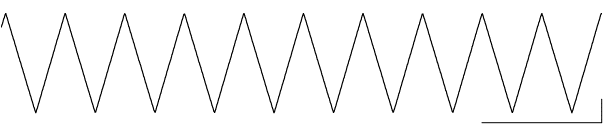
Most importantly, you can easily detect whether this problem is occurring by inputting a 100 Hz triangular waveform into the AD input and record say twenty or more 100 ms sweeps. If all the sweeps are like Fig. 1 with no extra notches, then you have no problems. (You could also try testing higher frequency triangular waveforms). However, if you see a notch such as shown in Fig. 2, then you have the bug, and the ‘LTP’ program should not be used on your computer. This notch occurs because the computer stops recording data (and stimulating) for 1-2 ms, but the waveform change continues, and therefore when it is next recorded it is at a much different amplitude.
As part of the ‘LTP’ program setup described in Section 2.8 of the ‘LTP’ Program manual and as one of the Conditions of Use, I stated that the program had to be tested with a triangular waveform input. I was serious about testing with a triangular waveform to basically make sure your equipment is working correctly, but the problem of dropout was then only one based on Murphy’s law. However, now that I have seen this bug on one computer, it could occur in others.
For now, if you are using a more recent computer I think you should definitely test your computer with a triangular waveform generator (eg Figs 1 and 2). Alternatively, if a waveform generator is not available, at least look at 50/60 Hz sine wave noise (everybody has that!). At minimum you should be aware of how your slope or popspike data would be corrupted by the 2 ms dropout.
PLEASE LET ME KNOW IF YOU FIND ANY COMPUTERS WITH THIS 2 MS DROPOUT PROBLEM.
In the next version of the program I will hopefully have the ‘LTP’ program automatically detect this error and exit if it occurs. In addition, I will try to install one of the newer PCI bus AD boards that have buffering for AD input and DA/TTL output.
I am still trying to find out the reason for this 2 ms dropout. (For you programmers out there, it even occurs when all interrupts are blocked by a non-trapped CLI instruction!!!)
Fig 1. In most computers (386’s to Pentium III’s), no signs of signal dropout are apparent when a triangular waveform is input into a Pico ADC-42 board. Trace is 100 ms in duration (calibrations: 2V, 20ms).
Fig 2. In the Dell R450 450 MHz Pentium II computer, signs of signal dropout are apparent when a triangular waveform is input into a Pico ADC-42 board. The top 100 ms trace shows the 2 ms dropout occurring about 43 ms into the trace. The bottom trace shows an expanded 30-60 ms section of the top trace with the 2msec dropout occurring about halfway through (calibrations: 2V, 20ms or 6ms, bottom).