'LTP' Program

Version 1.14J

William W. Anderson

(www.ltp-program.com)

Preview of LTP version 2: FENS meeting poster

On-line 'LTP' program manual

Conditions, Registration & Downloading the FREE 'LTP' program and manual

Rare but serious bug in LTP114J
Other LTP114J information

Upgrade information: LTP113E to LTP114J

Papers using the 'LTP' program


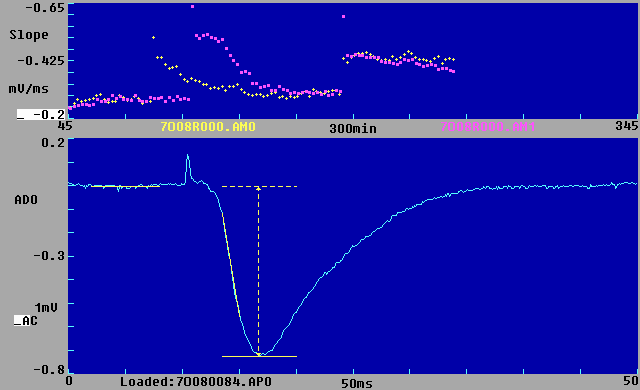
The 'LTP' program is a stimulation, data acquisition and on-line analysis program for studying Long-Term Potentiation (LTP), Long-term Depression (LTD), and related phenomena.

Click here to read the on-line LTP manual (1.13). For a FREE copy of the LTP program you must agree to the CONDITIONS for using the LTP program, REGISTER, and then DOWNLOAD the program (1.14J) and manual (1.13). Note: if you want to have a hard copy of the manual, it is best to print it out from the downloaded manual rather than from the web pages.

If you have any questions contact me at my email address: [email protected]. If I do not respond in 1 or 2 days, then please contact Dr. Steve Fitzjohn [email protected].


LTP Program functionality

  1. Y2K compatible (LTP113E and earlier are not Y2K compatible).
  2. The 'LTP' program records synaptic activity in extracellular, intracellular or patch clamp modes.
  3. Repetitive sweeps with simultaneous data acquisition (up to 1,800,000 samples on a 32 MB machine at 100 usec intervals) and stimulation (using two extracellular pathway stimulation, S0 and/or S1, and epoch-like digital and intracellular analog stimulation).
  4. The basic protocols are either slow single pathway S0 stimulation, or slow alternating dual pathway (S0 then S1) stimulation.
  5. The sweep data can be signal averaged on-line and digitally filtered off-line.
  6. On and off-line calculation and plotting of several waveform parameters: Peak Amplitude, Peak Latency, Slope, Area, Duration, 10-90% Rise Time, 10-90% Decay Time, Coastline, PopSpike Amplitude, PopSpike Latency, Average Amplitude, DC baselinel, Cell resistance (Rm), and Patch electrode series resistance (Rs) using peak and exponential curve fitting (in progress).
  7. LTP induction can be produced by: Single train, Repetitive train (theta stimulation), and Primed burst stimulation
  8. LTD stimulation and analysis can be performed using fast repetitive sweeps (at up to 2 Hz), or a single sweep lasting several minutes for faster repetitive stimulation.
  9. Plotting of ADsweep and Amplitude/Slope graphs on HP LaserJet printers.


LTP Program requirements

  1. Computers using DOS 6.x / Windows 3.x or Windows 95/98.
  2. 8-32 MB of memory.
  3. Data acquisition board (Axon Instrument' Digidata 1200, Scientific Solutions' Labmaster, and Pico Techology's Pico 42-ADC).
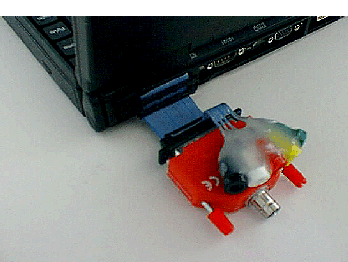
Photo of the low cost (ca. $150) Pico ADC-42 'board' connected to the parallel port of a laptop computer by a ribbon cable and two DB-25 plugs. The parallel port also produces four digital outputs.


Last updated July 13, 2000 by Bill Anderson.


Return to the Bristol MRC Centre for Synaptic Plasticity

Return to the Neuroscience Group page